Agave parryi var. huachucensis (Huachuca Agave) – Complete Growing and Care Guide (Cold Hardy Agave)
Botanical name:
Agave parryi var. huachucensis
Common name: Huachuca Agave
Origin: Southeastern Arizona (USA) and Northern Mexico (Sonora)
Plant type: Evergreen succulent (compact rosette-forming agave)
Size: 60–90 cm (24–36 in) diameter
Sun exposure: Full sun
Soil: Extremely well-drained, mineral soil
Cold hardiness: approx. −12°C to −15°C (10°F to 5°F)
Landscape use: Xeriscape, rock gardens, gravel gardens, containers
Agave parryi var. huachucensis, commonly known as Huachuca Agave, is a highly ornamental cold-hardy agave, valued for its elegant rosette form, balanced proportions, and strong architectural presence. Its refined structure and subtle symmetry make it an excellent choice for both minimalist and naturalistic landscapes.
Native to southeastern Arizona and northern Mexico, Agave parryi var. huachucensis grows in rocky, well-drained soils where it is exposed to intense sunlight, dry air, and significant temperature fluctuations. These conditions have shaped a plant that is highly drought-tolerant and well adapted to arid and semi-arid climates.
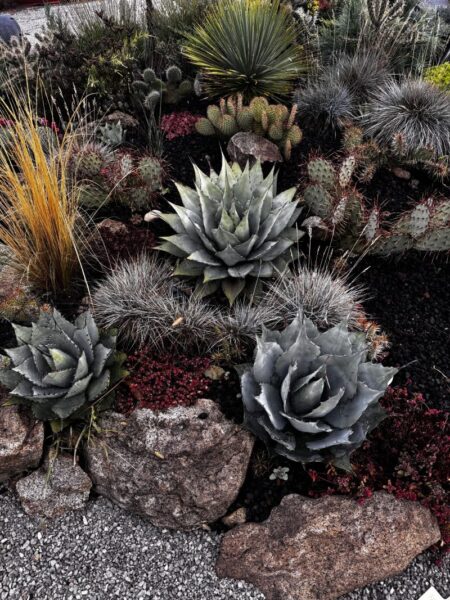
Plants typically form dense, well-structured rosettes ranging from 60 to 90 cm in diameter. The leaves are thick and slightly elongated, with a blue-gray coloration often highlighted by pronounced bud imprints and evenly spaced marginal teeth, ending in a strong terminal spine.
Agave parryi var. huachucensis is cold hardy down to approximately −12°C to −15°C when grown in well-drained soil. It performs best in dry winter conditions and is well suited for outdoor planting in climates where winter moisture is limited or carefully managed.
Like all agaves, it is monocarpic — flowering once at maturity after many years. The plant produces a tall flowering stalk with clusters of yellow flowers before the main rosette dies. It may also produce offsets, forming small, compact groups over time.
Because of its balanced form, moderate size, and strong visual impact, Agave parryi var. huachucensis is ideal for xeriscape gardens, rock gardens, gravel landscapes, and containers, where a durable and architectural focal point is desired.
Agave parryi var. huachucensis is a slow-growing, cold-hardy agave known for its well-structured rosette and thick blue-gray leaves. This variety develops a balanced, architectural form, creating a strong visual presence in gardens and landscapes.
Native to southeastern Arizona and northern Mexico, Agave parryi var. huachucensis grows in rocky, well-drained soils where water drains quickly and conditions remain dry for extended periods. These environments have shaped a plant that is highly drought-tolerant and well adapted to arid and semi-arid climates.
Over time, it develops a compact to moderately sized rosette typically reaching 60 to 90 cm in diameter. The leaves are thick and well-defined, with visible bud imprints, evenly spaced marginal teeth, and a sharp terminal spine. Its overall form is clean and structured, making it a reliable architectural plant.
One of the main reasons for its popularity is its ornamental value combined with reliable cold tolerance. It tolerates temperatures down to approximately −12°C to −15°C (10°F to 5°F) when grown in well-drained soil and performs best in dry winter conditions, making it suitable for outdoor planting in Zone 8 to 7b and similar climates.
Like all agaves, it is monocarpic — flowering once at maturity before the main rosette dies. This variety may produce offsets, forming small, compact clusters over time.
Growing Tips
-
Plant in full sun for best form and color
-
Use extremely well-drained, mineral soil (critical)
-
Water sparingly — allow soil to dry completely between waterings
-
Protect from winter moisture, especially in humid climates
-
Ideal for gravel gardens, slopes, and raised beds
-
Suitable for containers due to its balanced, compact form
When planted in dry, well-drained conditions, Agave parryi var. huachucensis is very resilient and can thrive for many years with minimal maintenance.
Agave parryi var. huachucensis Care Guide
Caring for Agave parryi var. huachucensis is straightforward when its natural habitat is replicated. This variety thrives in full sun, sharply drained mineral soil, and environments where moisture does not linger around the roots.
Compared to many agaves, it is relatively more tolerant but still requires excellent drainage to prevent rot. Long-term success depends primarily on keeping the root zone dry rather than frequent care. When planted correctly, it is extremely low-maintenance and long-lived.
How Often to Water Agave parryi var. huachucensis
Agave parryi var. huachucensis is highly drought-tolerant and adapted to dry, rocky soils with infrequent rainfall. It prefers dry conditions and is sensitive to overwatering, especially in cooler periods.
During the growing season, water only when the soil has completely dried out.
-
In containers: every 10–14 days in warm weather
-
In the ground: rarely needed; water only during extended drought
Water deeply but infrequently, ensuring fast drainage and no standing moisture.
In winter, watering should be stopped entirely for outdoor plants and kept to an absolute minimum in containers. Cold and wet conditions remain the primary risk, potentially leading to root and crown rot if moisture is not controlled.
Lighting Needs for Agave parryi var. huachucensis
Agave parryi var. huachucensis thrives in full sun and requires strong, direct light to maintain its compact rosette and characteristic blue-gray coloration. In its natural habitat, it is exposed to intense sunlight, which supports its structured form and well-defined leaves.
For optimal development, choose a location that receives at least six hours of direct sunlight daily, with full-day sun being ideal. In lower light conditions, the plant may lose its compact form, becoming more open and less defined.
When grown in containers, place the plant in the sunniest available location, such as a south-facing terrace, balcony, or open garden space. Due to its high light requirements, indoor growing is generally not suitable for Agave parryi var. huachucensis.
Soil and Fertilizer Secrets
Agave parryi var. huachucensis thrives in sharply drained, mineral soils and requires conditions where water moves quickly away from the roots. In its natural habitat, it grows on rocky slopes and gravelly soils where moisture never accumulates.
For successful planting, excellent drainage is critical. This variety does not tolerate heavy soils, and clay or compacted ground can quickly lead to root rot. Always amend the soil with gravel, crushed stone, or coarse sand to create a fast-draining, aerated structure.
When grown in containers, use a very fast-draining cactus or succulent mix with a high mineral content. Substrates rich in pumice, lava rock, coarse sand, or gravel are ideal. Organic matter should be kept minimal to avoid excess moisture retention.
Fertilization is rarely needed. Agave parryi var. huachucensis is adapted to nutrient-poor soils and performs best without frequent feeding. If desired, apply a light, balanced or low-nitrogen fertilizer once in spring to support steady, compact growth.
Temperature and Climate Requirements
Agave parryi var. huachucensis is adapted to arid and semi-arid climates where it experiences intense sunlight, dry air, and moderate temperature fluctuations. It is a cold-hardy agave suitable for many temperate regions, particularly in Zone 8 to 7b conditions.
In well-drained soil and dry winter conditions, established plants can tolerate temperatures down to approximately −12°C to −15°C (10°F to 5°F). This makes it a reliable choice for outdoor planting in milder cold climates.
As with most agaves, cold alone is rarely the limiting factor.
The most critical factor for survival is the combination of cold + moisture. Wet soil during winter significantly increases the risk of root and crown rot.
For best results, plant Agave parryi var. huachucensis in a sunny location with excellent drainage. In regions with wet winters, planting in raised beds, gravel gardens, or on slopes is strongly recommended to ensure long-term survival and stability.
Potting and Repotting Agave parryi var. huachucensis
Agave parryi var. huachucensis adapts very well to container growing when planted in a fast-draining, mineral-rich substrate and a stable, appropriately sized container. Its balanced but dense rosette makes it highly suitable for pots, though weight and stability are important.
Choose wide, sturdy pots that provide good balance for the rosette. Terracotta or unglazed ceramic containers are strongly preferred, as they allow faster evaporation and help reduce excess moisture.
The container does not need to be very deep, but it should be heavy enough to keep the plant stable and prevent tipping as it matures.
Always use containers with large drainage holes. Excellent drainage is essential — even short periods of retained moisture can lead to root or crown rot.
Repotting is infrequent, typically every 3–5 years. The best time to repot is in spring or early summer, during the active growing season.
When repotting:
-
Remove excess old soil carefully
-
Inspect roots for rot (cut if necessary and allow to dry before replanting)
-
Replant in fresh, sharply draining mineral soil
-
Keep the base of the rosette slightly above the soil level to prevent moisture buildup
How to Propagate Agave parryi var. huachucensis
Agave parryi var. huachucensis is most commonly propagated from offsets (pups), which it may produce over time. Seed propagation is also possible but is slower and less commonly used for practical cultivation.
When offsets are present, they are the easiest and most effective method of propagation:
-
Wait until the pup has developed its own roots
-
Carefully separate it from the mother plant
-
Allow the cut surface to dry (callous) for a few days
-
Plant in a fast-draining mineral soil
-
Water lightly after a few days, not immediately
This variety may produce offsets over time, allowing gradual propagation through division.
Seeds can also be used:
Sow in a well-draining substrate and keep in warm, bright conditions. Germination typically occurs within a few weeks, but seedlings grow slowly during the early stages.
Like all agaves, Agave parryi var. huachucensis is monocarpic. The plant flowers once at maturity, after which the main rosette dies. If offsets are present, the plant can continue growing as a small clump even after flowering.
How to Encourage Agave parryi var. huachucensis to Bloom
Agave parryi var. huachucensis produces tall flowering stalks with clusters of yellow flowers, but like all agaves, flowering cannot be actively controlled or accelerated.
This variety is monocarpic, meaning it flowers only once at the end of its life cycle, after which the main rosette dies. Depending on conditions, this typically occurs after many years of slow, steady growth.
Rather than trying to force flowering, the focus should be on maintaining optimal long-term conditions:
-
Full sun exposure
-
Excellent drainage
-
Minimal watering
-
Low-nutrient, mineral soil
Faster growth does not necessarily lead to earlier flowering. Overwatering or rich soil may weaken the plant and increase the risk of rot without significantly affecting the blooming timeline.
In suitable conditions, mature plants will eventually produce a tall flower stalk rising above the rosette, creating a strong architectural accent. If offsets are present, the plant may continue growing as a compact cluster even after the main rosette flowers and dies.
How to Properly Prune Agave parryi var. huachucensis
Agave parryi var. huachucensis requires minimal pruning, as it naturally forms a clean, well-structured rosette. It does not need shaping or regular trimming.
Pruning is limited to removing completely dry or damaged lower leaves. These can be carefully cut or gently pulled away to maintain a neat appearance, especially as the plant matures.
When pruning:
-
Use clean, sharp tools
-
Remove only fully dry leaves
-
Avoid cutting into healthy tissue
Take special care not to damage the center of the rosette, as this is the plant’s growth point. Damage there can permanently affect or kill the plant.
After flowering, the dried flower stalk can be removed if desired. Since agaves are monocarpic, the main rosette will not continue growing after blooming. If offsets are present, they will continue the growth of the plant.
Overwintering Agave parryi var. huachucensis
Agave parryi var. huachucensis is a cold-hardy agave suitable for temperate climates, particularly in Zone 8 to 7b conditions. When planted in well-drained soil and exposed to full sun, it can tolerate freezing temperatures down to approximately −12°C to −15°C (10°F to 5°F) with minimal damage.
The most critical factor during winter is not temperature, but moisture. Wet soil during cold periods is the primary cause of failure and can quickly lead to root and crown rot.
To improve winter survival:
-
Plant in raised beds, slopes, or gravel gardens
-
Ensure water drains rapidly away from the plant
-
Avoid areas where water accumulates
-
Keep the crown as dry as possible
In regions with wet winters, additional protection is strongly recommended. Simple rain covers or planting under eaves can significantly reduce moisture exposure and improve long-term survival.
Young plants and container-grown specimens are more sensitive and may require extra protection during prolonged cold or wet conditions. Moving containers to a sheltered, dry location can greatly reduce winter stress.
Established plants require very little care when planted correctly. With excellent drainage and full sun exposure, Agave parryi var. huachucensis can tolerate winter conditions with minimal intervention.
How to Plant Agave parryi var. huachucensis
Planting Agave parryi var. huachucensis correctly is critical for long-term success. This variety requires fast-draining soil and full sun exposure. Proper drainage remains the most important factor for healthy growth.
Below are the two main planting methods.
Planting Agave parryi var. huachucensis in Containers
-
Choose a wide, stable container (terracotta preferred)
-
Ensure large drainage holes — critical
-
Use a sharply draining mineral mix (gravel, pumice, sand, lava rock)
-
Position the plant so the base of the rosette sits slightly above soil level
-
Place in a fully sunny location (terrace, balcony, garden)
-
Water lightly after planting, then allow soil to dry completely
Planting Agave parryi var. huachucensis in the Ground
-
Select a location with full sun exposure
-
Avoid flat or low areas where water collects
-
Improve drainage with gravel, crushed stone, or coarse sand
-
Plant on a mound or slope to ensure fast runoff
-
Keep the rosette base slightly elevated above soil level
-
Backfill with mineral-rich soil and firm gently
-
Water lightly once to settle the soil
Other Popular Types of Agave
Agave parryi var. huachucensis is part of a diverse genus that includes many striking species valued for their strong geometry, drought tolerance, and architectural presence in dry landscapes.
Different agave species vary in size, leaf structure, color, and cold hardiness, making them suitable for a wide range of uses—from compact container plants to large focal specimens in xeriscape gardens.
If you appreciate the structured form, blue-gray tones, and architectural presence of Agave parryi var. huachucensis, you may also want to explore other agave species with similar ornamental value and adaptability.
Some popular choices include:
-
Agave parryi (Parry’s Agave) – compact, highly symmetrical, cold hardy
-
Agave montana – mountain species with strong structure and good cold tolerance
-
Agave ovatifolia – larger rosette with broader leaves and bold presence
-
Agave utahensis – smaller, hardy species for dry climates
👉 You can explore more species in our Agave plants collection.
You May Also Like


Common Pests and Problems of Agave parryi var. huachucensis
Agave parryi var. huachucensis is a very resilient plant and rarely suffers from serious pest or disease issues when grown in full sun and sharply drained soil. Most problems are not caused by pests, but by excess moisture, poor drainage, or incorrect growing conditions.
Pests
Agaves are generally resistant to pests, especially in dry, outdoor environments.
Occasionally, the following may appear:
-
Scale insects – attach to leaves and feed on plant sap
-
Mealybugs – small white insects hiding near the base of leaves or within the rosette
In most cases, infestations are minor and can be controlled by:
-
Manual removal
-
Insecticidal soap or horticultural oils
Plant Problems and Diseases
The most common issues are moisture-related, not pathogen-driven.
Root and Crown Rot
The most serious problem for Agave parryi var. huachucensis is rot caused by excess moisture.
Symptoms include:
-
Soft or collapsing leaves
-
Discoloration near the base
-
Foul smell or mushy tissue
This usually occurs when:
-
Soil drainage is inadequate
-
Water collects in the rosette
-
Cold and wet conditions combine
Fungal Issues
Fungal spotting may appear in humid environments, but it is usually cosmetic and rarely dangerous.
Prevention
-
Use extremely well-drained soil
-
Avoid watering during cool or humid periods
-
Keep the rosette center dry
-
Ensure good air circulation
Where to Buy Agave parryi var. huachucensis Plants
If you are looking to add this ornamental, cold-hardy agave to your garden or collection, Agave parryi var. huachucensis plants are available in our online shop. We offer carefully grown specimens suitable for both landscape planting and container cultivation.
Our plants are selected for strong root systems and healthy development, ensuring they establish quickly and perform reliably in a wide range of conditions. Whether you are creating a xeriscape garden, a gravel landscape, or a structured container display, Agave parryi var. huachucensis is a dependable choice with minimal maintenance requirements.
Healthy, cold-hardy Agave parryi var. huachucensis plants grown in our desert garden nursery.
👉 Browse available Agave parryi var. huachucensis plants in our shop
Quick Reference
Final Thoughts
Agave parryi var. huachucensis is a reliable and visually striking choice for sunny, dry gardens. With its balanced form, blue-gray leaves, and strong architectural presence, it stands out as one of the most adaptable cold-hardy agaves for xeriscape and modern landscape designs.
When planted in sharply drained, mineral soil and exposed to full sun, Agave parryi var. huachucensis is easy to grow and requires minimal maintenance. Its structured rosette, slow growth, and long lifespan make it an excellent choice for both landscape planting and container cultivation.
Whether used as a focal point in a gravel garden or as part of a clean, minimalist outdoor space, it brings a strong, sculptural presence that remains attractive throughout the year.
Among cold-hardy agaves, Agave parryi var. huachucensis is a dependable and versatile choice for long-term success, especially in climates with dry winters and well-controlled moisture.
FAQ About Agave parryi var. huachucensis
How fast does Agave parryi var. huachucensis grow?
Agave parryi var. huachucensis is a slow-growing plant. In most conditions, it adds only a few centimeters per year, gradually forming a well-structured rosette rather than increasing in height.
Is Agave parryi var. huachucensis cold hardy?
Yes, it is a cold-hardy agave. In dry conditions and well-drained soil, it can tolerate temperatures down to approximately −12°C to −15°C, making it suitable for Zone 8 to 7b and similar temperate climates.
Can Agave parryi var. huachucensis grow in pots?
Yes, it grows very well in containers. Use a wide, stable pot with excellent drainage and a mineral-based soil mix. Container growing is especially useful in wet climates, as it allows better control over moisture.
How often should Agave parryi var. huachucensis be watered?
Water very infrequently. Allow the soil to dry completely between waterings. In containers, this typically means watering every 10–14 days in warm weather, while plants in the ground often require little to no watering once established.
Does Agave parryi var. huachucensis bloom?
Yes, but only once. Like all agaves, it is monocarpic and flowers at the end of its life cycle, usually after many years. After flowering, the main rosette dies; if offsets are present, they continue the plant.
What soil is best for Agave parryi var. huachucensis?
It requires very well-drained, mineral soil. A mix containing gravel, pumice, lava rock, or coarse sand is ideal. Avoid heavy or organic-rich soils that retain moisture.
Why is my Agave parryi var. huachucensis rotting?
In most cases, rot is caused by excess moisture, not cold. Poor drainage, wet soil, or water trapped in the rosette during winter are the most common causes of plant failure.
Guides
If you want to learn more about growing desert plants and yuccas, explore our detailed guides below. These articles will help you create a healthy environment for your plants and improve your gardening success.